
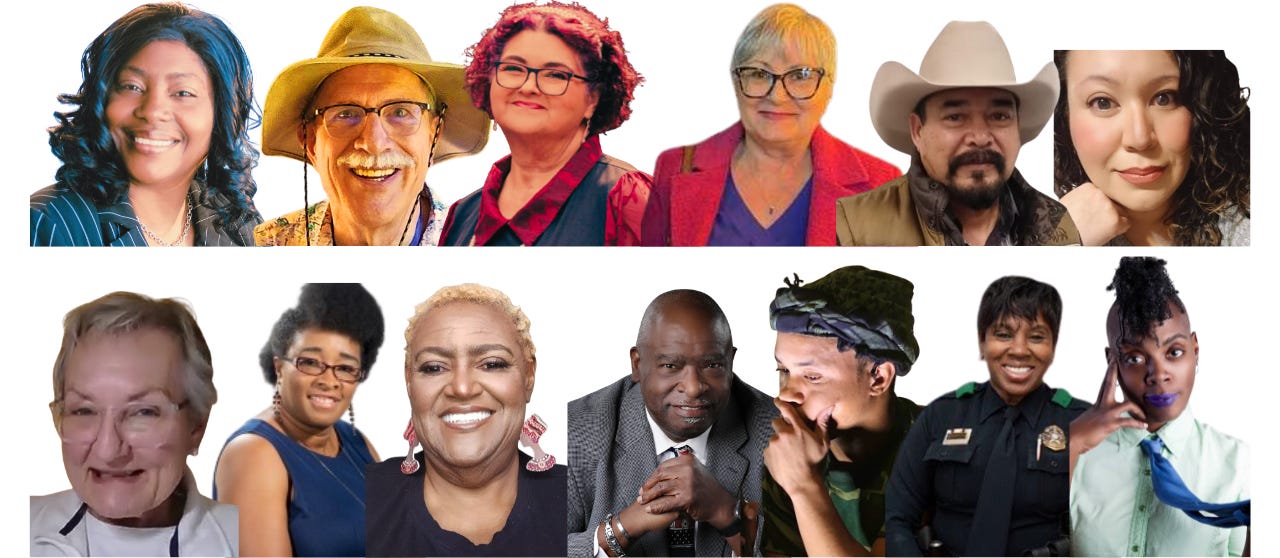
Well, I privately didn’t think that it was possible, but last month I released the 12th episode of my podcast. That marks a year of interviewing activists in Dallas County making their communities better places to live.
I came up with the idea of the show, honestly, on a whim. In my mind, there exists two broad categories of political podcasts: the one with the talking head(s) shouting unearned takes that they think everyone should espouse, and the one in which activists are immediately interviewed about policy. I can’t stomach either format.
The first relies on a sort of cultlike following in which listeners develop an almost parasocial relationship with the podcaster, and the second starts the activist’s story somewhere in the middle of their life. I’m much more interested in how the activist got to where they are today, how policy affects them and how they’ve helped shape policy, and the lessons that we can glean from their life.
I attempted to book as diverse a guest list as I could. By diverse, I don’t just mean race; diversity manifests itself not only in race, but in upbringing, career choices, passions, and skill sets.
For instance, Subrina Brenham, the show’s first guest, had always been civic-minded, but as a local business owner, she wondered who was actually paying attention to her community before she decided to run for office.
Michele Saranovich grew up in the Pacific Northwest and worked for the United States Department of Energy, helping form the newly created Office of Civilian Radioactive Waste Management.
And Julio Chaparro is an immigrant from Mexico who, with his daughter, Aggi Alvarado, are currently fighting the billion-dollar asphalt shingle company known as TAMKO, which is polluting their community of Joppa. These and the rest of my guests brought something unique to the table.
To recap, here is each episode’s landing page:
Ep. 1 | Subrina Brenham: A Lifetime of Community Service
Ep. 2 | Dave Henley: From Navy Meteorologist to Environmental Activist
Ep. 3 | Esme Zuniga: Generations of Family Members Serving the People
Ep. 4 | Michele Saranovich: How One Woman from the Pacific Northwest Helped Build the Department of Energy
Ep. 5 | Julio Chaparro & Aggi Alvarado: An Immigrant Family’s Fight Against a Billion-Dollar Polluter
Ep. 6 | Connie Cook: A Veteran Nurse’s Journey Through American Healthcare Struggles
Ep. 7 | Olinka Green: Living Dallas Racism and the Legacy of the Black Panthers
Ep. 8 | Donna Wilson: From Personal Trauma to Voting and HIV Advocacy
Ep. 9 | Mathis Perkins: Wisdom from a Veteran About Community, Purpose, and Resilience
Ep. 10 | Yafeuh Balogun: Intergenerational Activism and Community-Building in Dallas
Ep. 11 | Sophia Graham: How West Dallas Built a Cop With Purpose
Ep. 12 | Lei Lei Lashawn: Creating Art to Heal Trauma and Fight Injustice
Curious to see what patterns emerged from a full year of conversations, I looked back at how my guests answered three core questions.
“What is the best thing about [X], and what is the biggest room for improvement?”
At the end of (almost) each episode, I asked guests what they view is the best thing about Dallas, their community, or a broader social movement, as well as the biggest room for improvement. (I say almost because Olinka Green’s feed dropped right before I asked this question.)
Best thing
After 11 answers for the best thing, I placed each into one of three categories:
Community: The answer has something to do with the people in the community
Social Movement: Something inherent about the social movement is what makes [X] so great
Other: The answer has to do with something else
Here’s a chart of what I discovered for what guests believe is the best thing:
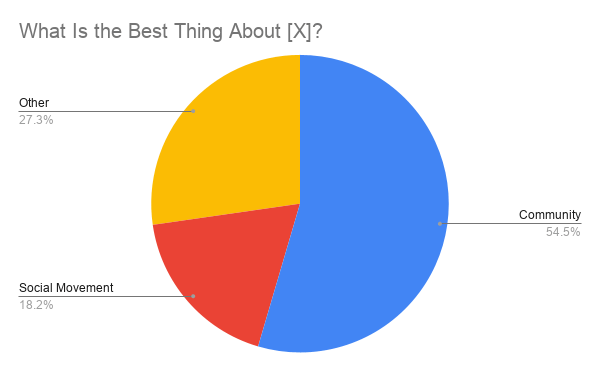
Over half of the responses had to do with the people in the community. Here are some notable answers:
Dave Henley: A large population of Dallas residents who genuinely care about the environment and are willing to put in the work to build a clean future, bringing about the city’s Comprehensive Environmental and Climate Action Plan (CECAP)
Connie Cook: The incredible resilience of ordinary working people
Lei Lei Lashawn: Dallas’ solid, highly diverse, and country-rooted people
Biggest room for improvement
And after analyzing the responses for what my guests deem is the biggest room for improvement, I created two categories:
Government: Government, especially municipal government, is impeding progress
Discrimination: Societal discrimination is dividing us
And what did I discover? By far, their chief source of frustration is the government, with over 80% stating so:
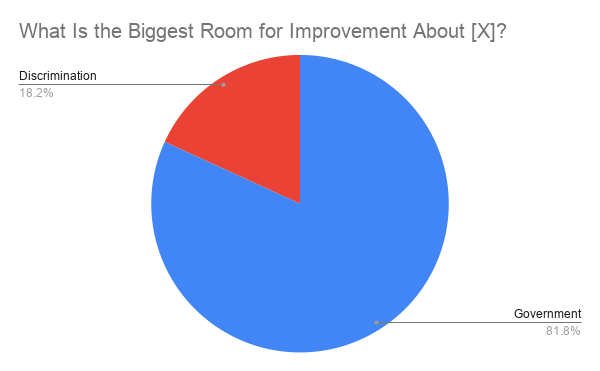
Here are some insightful answers:
Esme Zuniga: Local political leaders who refuse to work with grassroots campaigns out of fear of appearing "woke"
Mathis Perkins: Advocates for local government to include more public amenities to support Oak Cliff’s beauty (like walking trails, larger libraries, crystal lagoons, and community health clinics)
Yafeuh Balogun: Demands more transparency in municipal government, pointing out that citizens are locked out of the backdoor deals made by big business elites and developers
That progressives possess an abiding love for their fellow community members and have deep reservations about the government refutes common political narratives that the opposite is the case. I am almost certain that conservative activists also trust their neighbors much more than the government, which puts us all in an awkward standoff.
But one element rings true: the government is one of the most disliked and mistrusted institutions in America. I think that it’s fair to say that civically engaged everyday people of all political stripes want their elected leaders to listen to their needs and reject the influence wielded by more powerful interests.
The differences between progressives and conservatives, however, lie in our upbringing and general belief systems. That piece of the discussion sits outside of the scope of this post, but this reality offers little comfort to those calling for unity between the two camps.
“Where do you see [X] in 10 years?”
The other question I asked is where my guests saw their communities or social movements in a decade. I grouped their responses into three categories:
Generally Positive: It’s always sunny in Dallas
Generally Negative: Stormy weather since my guest and I ain’t together
Mixed: One big shrug emoji
And the results? Virtually evenly split among the three categories:
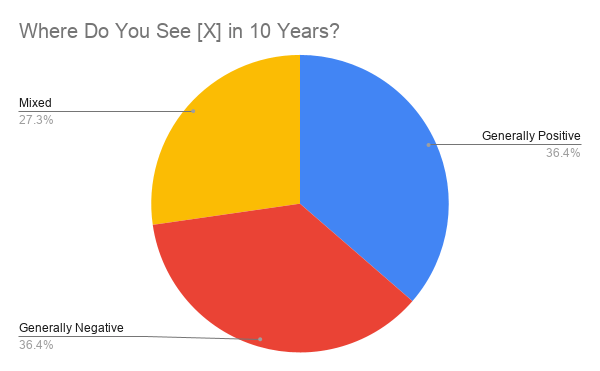
Here is an example of each:
Generally Positive: Donna Wilson reckons that Dallas will end the HIV epidemic if we eradicate the deep social stigma that currently prevents people from getting tested, seeking treatment, or speaking out
Generally Negative: Sophia Graham stated that Dallas will find itself “in a hole,” attributing the gloomy outlook to the fact that people and leaders still refuse to work together across racial, ethnic, and economic lines
Mixed: Julio Chaparro hopes that the site of the current TAMKO factory will be replaced by useful community developments, though he and Aggi Alvarado acknowledge the very real risk of gentrification and desperately hope to avoid it in a historic community like Joppa
So in the end, based on these three datasets, we love our communities, question our political leaders’ willingness to serve us, and quietly wonder if our actions will matter at all. If you recently started this kind of work and you prefer clean, fairytale stories mostly to justify your civic involvement, these findings may not suit you. You may ask why activists even undertake the job of trying to improve their communities when it seems to present mixed results while risking one’s well-being. The answer, I believe, derives from the next dataset.
Sense of civic involvement instilled by their parents
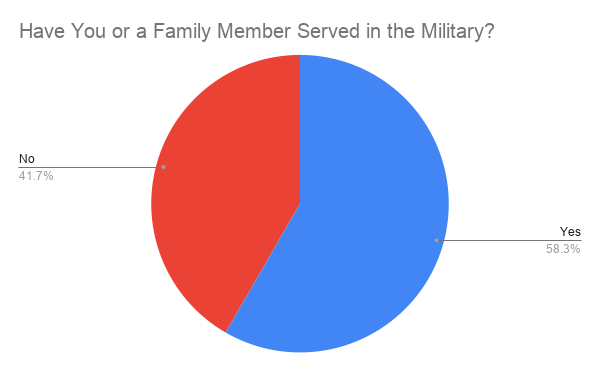
After about my third episode, I noticed a striking thread: all of my guests at that point had family members (mainly parents) who instilled in them a sense of civic duty. As I conducted more interviews, I realized that that community involvement expressed itself primarily through military service.
I examined the backgrounds of all 12 activists to see if they or a family member served in the military. The results were close, with 7 of them fitting this profile:
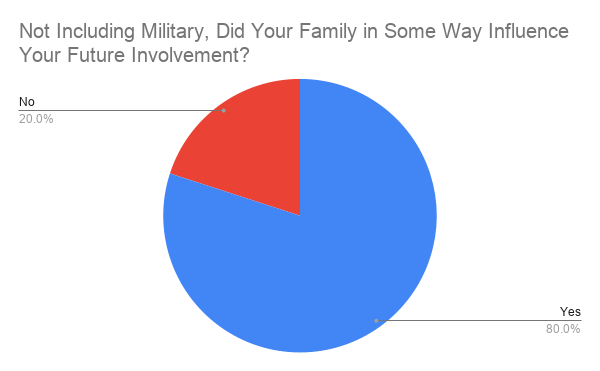
For the 5 with no history of military service, I broadened the query to include family members who in some way influenced their future work. This may mean having parents who volunteered in their community or whose career choice shaped the activist’s later career. The results were clear, with all but one fitting this description:
Here are some examples of people whose family helped mold their sense of duty:
Michele Saranovich’s father worked as an engineer who spent his career building massive hydroelectric dams along the Columbia River in Oregon and Washington State, which heavily influenced Michele's life and her eventual career in energy policy
Olinka Green’s mother took her to a Black Panther meeting in California at a very young age, and spent 33 years in and out of prison as she closely tracked Olinka’s social justice work
Donna Wilson’s adoptive mother was a passionate community advocate who did a great deal of volunteering and political work, later introducing Donna to prominent local figures like Al Lipscomb and Dwaine Caraway
The takeaway? Civic involvement is rarely born in a vacuum; it’s an institutional legacy handed down by family.
In fact, the only guest who seems to buck the trend of familial involvement in civics is Julio Chaparro. While Julio had a fun childhood in Mexico, his parents eventually separated, and his father was not a present figure in his life. Julio’s story is one of relentless grit in the face of extraordinary circumstances.
But this data does strongly suggest that family plays an outsized role in one’s civic involvement. While that dynamic may feel innocuous, it poses foundational challenges for how we as citizens and residents can become engaged. Simply put, we cannot merely depend on an uncontrollable variable like encouragement from family members in order to begin shaping our own communities.
We need structural solutions aimed at fixing the lack of civic engagement
Readers of mine know that I consistently harp on about the responsibility of local Democratic parties to carry out the difficult, infrastructural work of bringing community members into the fold at the local level. This would, in the long run, increase civic engagement and voter participation.
But reaching out to communities largely ignores the one demographic that I’ve been indirectly referencing in this analysis: the youth. Almost all of my podcast guests were greatly impacted at a young age by watching a family member carry out their civic duty, in turn inspiring the guests to forge their own paths. The idea, therefore, is to get them while they’re young.
I am no education expert, so I do not have fleshed-out solutions for how we can instill a sense of civic duty in children. I will, though, highlight some of the bright spots and systemic challenges that we face as we try to architect that framework.
National view
During the 2008 presidential campaign, Barack Obama issued a “Call to Service,” where he planned to, among other things, set “a goal of having middle and high-schoolers contribute at least 50 hours a year to community service, and reach that goal through national guidelines for service-learning and additional resources for schools to develop successful programs.”
Only a few months after he took office, Obama signed the Edward M. Kennedy Serve America Act, which heavily incentivized youth volunteerism through financial rewards and grant programs. But the 50-hour mandate of community service failed to make the cut, with conservative lawmakers and commentators balking at the horror of loading backpacks with books and goodies for children of military parents.
As a result, youth service today remains highly fragmented, with some states and various individual school districts eventually adopting their own strict community service hours for graduation. Other states have left it entirely optional or tied to state scholarship incentives.
If we were serious about inculcating in young people a sense of service to their communities, however, we would revisit this now-forgotten mandate championed by Obama almost 20 years ago. We plainly cannot continue to accept an uneven landscape of youth civic engagement. Obviously, that also means first electing a Democratic president and Democratic House and Senate. There is no other way around that.
Local view
While state boards of education and individual school districts can certainly embrace their own standards for youth volunteering, in a red state like Texas, that proves difficult. While I don’t have a similar policy recommendation at the local level, I keep remembering an event that happened at Dallas City Hall just this year.
This past April, on Earth Day, Dallas City Council approved setting aside an emergency fund to research ways to amortize two toxic factories — TAMKO in Joppa and GAF in West Dallas. I attended, made a statement, and wrote about it here. Over 40 other speakers approached the podium and passionately made the case for removing the two plants. One group of speakers, though, stood out.
Twelve students from White Rock Montessori attended virtually while sitting in their classroom. One by one, they made their case, citing dirty air and asthma statistics, with their teacher, Ms. Gamber, sitting beside them. Ms. Gamber, who grew up on the Oak Cliff border with West Dallas, had actually taken her class to the area next to GAF to experience breathing the air. It left such an impression on the students that they urged Dallas City Council to take immediate action. Needless to say, the children left an impression on the rest of us as well.
Now, a private school like White Rock Montessori in a politically blue community like East Dallas enjoys certain privileges that Texas public schools at large do not. It does not need to report to a public school board, and the parents of the students are more likely to lend support to a social cause that a teacher is fighting for. So while we may find it formidable to implement local policy changes for students to become more civically involved, perhaps the other way is to seek the leadership of nonprofits already shouldering that responsibility.
In Dallas, organizations like March to the Polls and Big Thought are aggressively filling in the gaps created by a lack of civic infrastructure in our state. March to the Polls’ Student Voter Empowerment Clubs are student-led clubs that promote “civics education and participation through dynamic year-round, peer-to-peer outreach activities and hands on learning experiences.” Big Thought’s “direct-to-youth programs cultivate skill development through meaningful relationships, fostering connections that equip youth with sustainable skills essential for their success.” Organizations like these comprise the rich ecosystem of youth civic engagement that red states like Texas desperately need.
Conclusion
So, what did I learn after a year of interviewing Dallas activists? I learned that they’re a rare breed.
A vanishingly small number of people ever decide to take active roles in their communities. The vast majority of people can’t be bothered to care about much outside of their own homes. While it’s easy to blame them, it is also easy to ignore the systemic causes of that apathy. Our own governments often choose not to prioritize civics, and our parents, depending on their history, may or may not bestow upon us a sense of civic pride. These are variables that one cannot easily control. To even make it this far as an activist is to beat the odds that society and life have placed against you.
But those activists are the reason that we enjoy the small things that we take for granted every day.
I found this a fascinating read, AZ! And congratulations on 12 interviews completed -wow! I was wondering, do you fit the pattern of watching your family be civically engaged while you were young?