
You know what time it is.
I planned to do a data analysis for the May 2 local elections, specifically for the four Dallas ISD propositions, but the results didn’t yield a ton of interesting insight. Voters overwhelmingly approved all four propositions.
As for this most recent election, specifically concerning the battle for Congressional District 33 between Colin Allred and Julie Johnson, that’s another story. I’m not going to delve into the political drama of how both candidates hobbled to the finish line, but I will highlight how voters in different communities made their voices heard.
TLDR
Colin Allred won economically disadvantaged communities of color by huge numbers, while Julie Johnson won predominantly middle-class white communities by smaller margins.
Allred won those less-populated communities by just enough margins to offset Johnson’s victories in more-populated communities.
This election is yet another one that highlights the divides between race and economic opportunity among Democrats in Dallas County.
And of course, the AI explainer video.
Overall turnout
Overall, 5.31% of registered voters in CD 33, which lies entirely within Dallas County, turned out to vote. Dallas County as a whole experienced a 4.72% turnout in the Democratic primary runoff, so the CD 33 race generated more excitement than in other parts of the county.
Here are the top five communities that cast their ballots in CD 33.
Lake Highlands: 9.48%
Far East Dallas: 8.31%
Buckner Terrace: 8.28%
Greenville: 7.42%
North & West Oak Cliff: 6.14%
And the bottom five.
Pleasant Grove: 3.83%
Kiest Park: 3.65%
Grand Prairie: 3.18%
Southwest Dallas: 3.00%
Kleberg-Rylie: 2.67%
(Technically, South Dallas had the lowest turnout at 0%. But only one precinct in South Dallas belongs to CD 33, and that precinct contains just 51 registered voters. So I excluded South Dallas from the analysis to provide a better representation of the data.)
Congratulations to Lake Highlands for turning out the highest rate of its registered voters.
The Bellwether Award for Overall Turnout goes to East Dallas, with 5.36% of its registered voters making their voices heard.
(In my world, East Dallas encompasses neighborhoods like Old East Dallas, Lakewood, and Deep Ellum. Far East Dallas includes neighborhoods like Casa View, Casa Linda, and Forest Hills. Because it’s my Substack and I can do what I want.)
As we keep witnessing for each election, in general, more economically advantaged communities march to the polls at higher rates than economically disadvantaged ones.
Buckner Terrace serves as a notable exception, which I’ve glowingly written about as a community that consistently punches above its weight. Democrats here show up and show out for elections big and small.
Communities that supported Allred vs. Johnson
While turnout rates often reflect economic advantage, a closer look at the actual vote split reveals how different communities chose their candidate.
To start, Allred garnered 53.92% of the overall vote while Johnson received 46.08%.
Here are the top five that supported Allred.
Kiest Park: 78.64%
Pleasant Grove: 77.07%
Balch Springs: 76.52%
Kleberg-Rylie: 75.63%
Piedmont: 75.38%
And the top five for Johnson.
North & West Oak Cliff: 65.00%
Greenville: 57.10%
Far East Dallas: 54.23%
East Dallas: 54.02%
Northwest Dallas: 51.54%
We notice that Allred vastly outperformed Johnson in not just communities of color, but in mostly lower- to lower-middle-class ones. Kiest Park, his best performance and a predominantly black community in Oak Cliff, rewarded him with a whopping 78.64% of the vote. Even his #5, Piedmont, handed him an astounding three-quarters of the share. Voters in these communities seemed to trust Allred more than Johnson.
Johnson, for her part, did well in largely middle-class communities. North & West Oak Cliff, with neighborhoods like Kessler Park and Bishop Arts, gave her a comfortable share of the vote.
Meanwhile, the Bellwether Award for supporters in this race goes to Downtown Dallas, with 53.03% breaking for Allred and 46.97% moving toward Johnson. (In my world, Downtown makes up Downtown Dallas, Uptown, and Oak Lawn.)
The interesting thing is that Downtown Dallas, a predominantly white and financially well-off community, did not align with most other white and financially well-off communities in supporting Johnson. It may be that the younger residents of Downtown found Allred, a younger candidate and former NFL player, more compelling than Johnson.
But while Downtown was the exception, by and large, lower-middle-class communities with black and Hispanic voters supported Allred while white and middle-class communities supported Johnson.
How Allred won
Another fascinating phenomenon occurred in this election. Rather than paying attention to turnout rates, let’s examine the raw number of ballots cast for each community and cross-reference that data with how each voted.
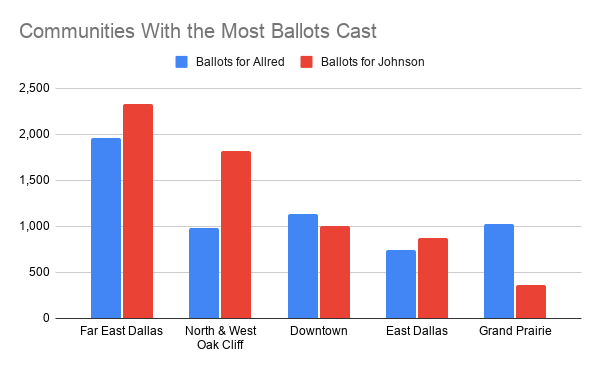
Here are the five communities with the highest number of ballots cast.
Far East Dallas: 4,287
North & West Oak Cliff: 2,800
Downtown: 2,148
East Dallas: 1,616
Grand Prairie: 1,384
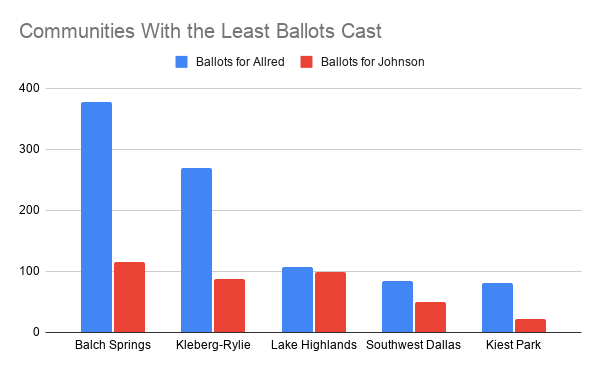
And here are the bottom five.
Balch Springs: 494
Kleberg-Rylie: 357
Lake Highlands: 206
Southwest Dallas: 135
Kiest Park: 103
And how did each community vote? Here are the top five that cast their ballots and how many of those ballots each community granted both candidates.
And here are the communities with the least ballots cast.
We note that for the top five communities with the most ballots cast, Johnson won three of them, netting her 543 more votes than Allred in those top five.
But in the bottom five, Allred won every community, which earned him 547 more votes than Johnson in those bottom five and a net of 4 votes between the top five and bottom five. His outright dominant performances in Balch Springs and Kleberg-Rylie helped net him those 4 votes.
In reality, however, the fact that he managed to escape being consistently blown out across the district, particularly in high-population communities, is what won him the election. This strategy somewhat resembles the one employed by Amber Givens in her win over incumbent John Creuzot for Dallas County District Attorney. There, the challenger kept it close enough across the county while gaining support from key communities.
But whereas Givens’ best performance came with a 64% win in one community, Allred trounced Johnson with at least 70% of the share in seven communities. Even in shallower pools of voters, like Balch Springs and Kleberg-Rylie, 70% is still a lot of votes. Allred formed his coalition based on deep support in more economically disadvantaged communities of color while performing just competently enough elsewhere to guarantee victory.
Don’t like it? Try to understand people who do
The election for Congressional District 33 is the latest in a string of elections this year that have highlighted the stark divisions along lines of class and race among Democrats in Dallas County. Those divisions reveal themselves especially on Facebook, with activists from separate camps shouting past each other and creating groups to feel safe.
But to begin mending these fences, we have to stop believing that elections are about policy proposals and stances on issues. Instead, elections represent how voters in a given district view how they fit in society, and who they think will give them the best chance to implement that fit. On the national level, the dialog frequently revolves around the economy. At the more local level, the talk shifts to power dynamics and who sits at the table. On both levels, though, identity and belonging command much of the cognitive load.
What does that mean on a practical level? If voters in a given community feel left out of the discussion mostly controlled by voters in other communities, the voters in that given community will respond by voting for the candidate who might stick it to the leaders of the other communities.
So if a district attorney talks to mostly white and affluent residents in a county led by mostly black and Hispanic Democrats, voters are more likely to vote for the candidate who promises to buck that trend.
Conversely, voters in a fundamentally conservative state who quote scripture to make sense of the world — or who are comfortable with those who do — might back a candidate who holds a Master of Divinity and uses those theological teachings to justify his up-down political perspective.
The same can be said about CD 33. If we want different outcomes, we should attempt to understand people who oppose those outcomes. That means, among other things, inviting them to our events or, better yet, attending theirs. If we truly fashion ourselves as progressive, we should feel confident enough in our belief system to be challenged by other well-meaning Democrats who share our deep desire to create a better world for all.
Now let’s focus on November.