
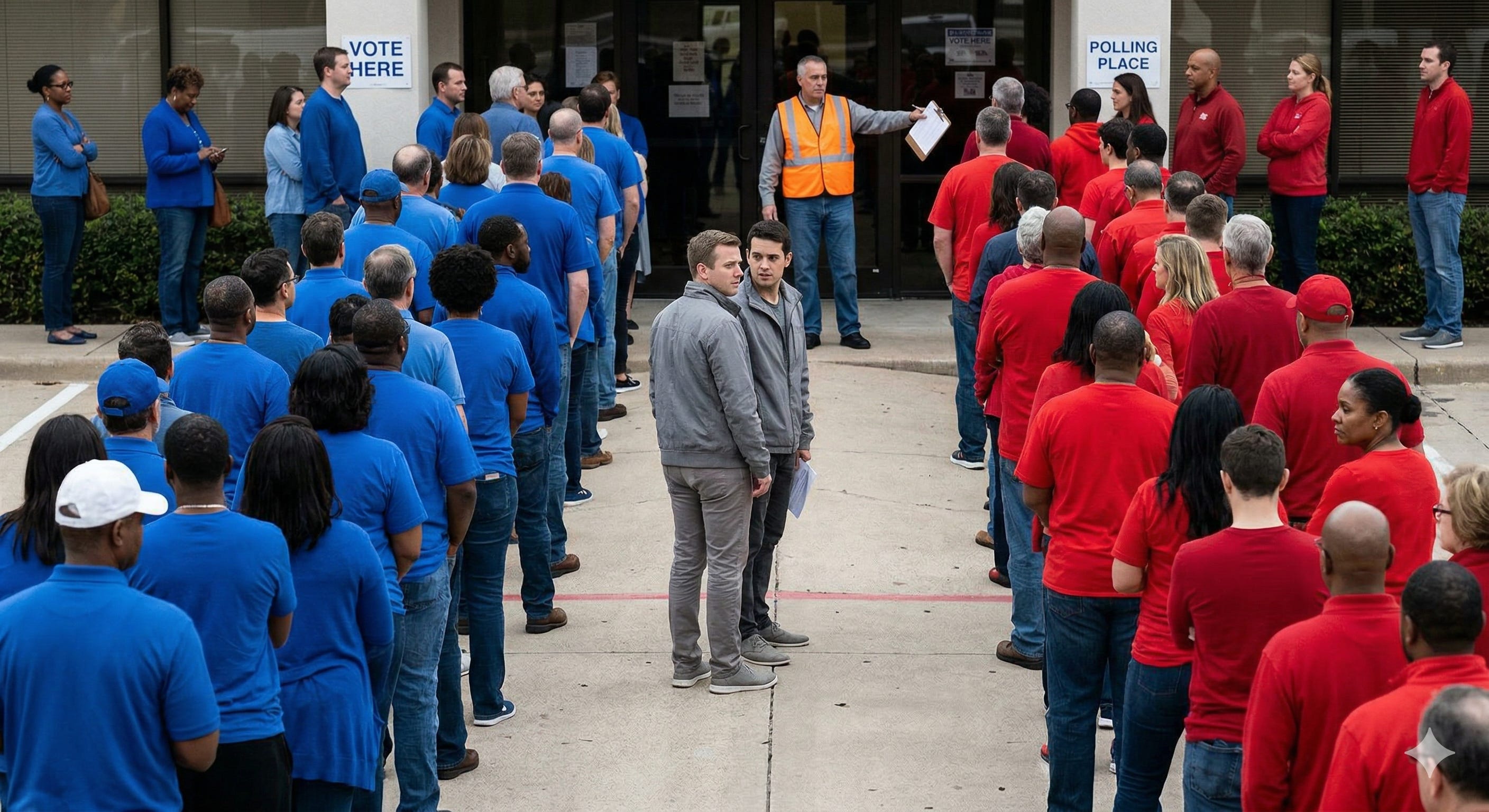
Before we begin, I realize that city council elections in Texas are nonpartisan, meaning that candidates do not run as part of a political party. But we all know who’s actually a Democrat and who’s actually a Republican.
Happy Local Election Season! Early voting for local elections starts Monday, April 20. Election day is Saturday, May 2.
If you live within the Dallas Independent School District boundaries, there is a crucial investment in our students that we must support. At the price of $2.79 per month for taxpayers, this bond aims to build new campuses, eliminate more than 700 portable classrooms, improve safety, ensure modern technology, and make critical repairs to campuses.
And of course, city council races are also happening across the county. So go out and vote!
Also, because we’re going through another election cycle, I started diving into more oodles of data.
TLDR
In May local elections in Dallas County, partisan Democrats and partisan Republicans tend to make up a great majority of the electorate.
In November 2024, the City of Dallas passed Proposition D, which moved its local elections from May to November of odd-numbered years.
The hope is, among other things, to increase democratic participation, which means a higher turnout. But the unspoken logic among reformers is that higher turnout automatically leads to less partisanship.
According to the data, however, while the overall number of voters in November of odd-numbered years surpasses that of May, the share of partisans remains high in both scenarios.
My suggestion to get inconsistent voters to cast their ballots for their local leaders? Read to find out.
Before we get into it, here it is again. Your favorite part of these long-winded Substack posts. The AI explainer video:
Background
As part of my work, I recently crunched numbers for a couple of city council campaigns in Dallas County. When I do this, I look up past election data and cross-reference it with demographic data to figure out the lay of the land. This time, however, since one of my particular races involves a partisan Democrat and a partisan Republican vying for the same seat, I decided to cross-reference the election data with how Democratic or Republican this community’s voters actually are. I do this by looking up the DNC Dem Support score, a proprietary calculation meant to suss out a voter’s partisan leanings, available on VAN, a huge database provided by the Democratic Party and one that most political insiders utilize or at least have heard of.
DNC Dem Support score
The DNC Dem Support score ranges from 0 to 100. The lower a voter’s score, the more likely they are to be a Republican. The higher a voter’s score, the more likely they are to be a Democrat. The calculation considers multiple factors when assigning scores, but much of it deals with how often voters visit the polls during primary elections in March.
For context, Democratic precinct chairs and officials, if they’ve been voting for a while, tend to score well into the 90s. I suppose the same can be said of their Republican counterparts and the likelihood that those Republicans score in the single digits.
Local elections in May
Result for a recent May election in this community
I gathered the data for a recent May local election in this candidate’s community, and I cross-referenced it with those voters’ political propensities. And what I discovered took me aback:
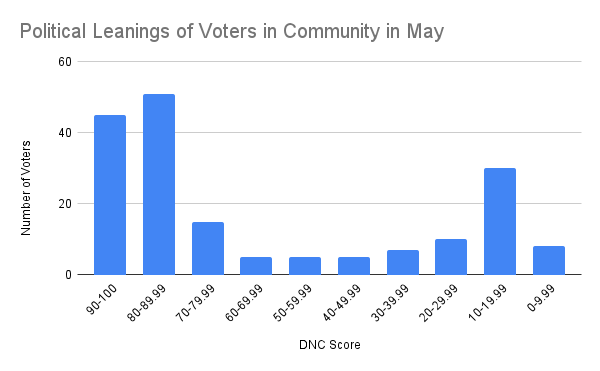
On the left stand the partisan Democrats, scoring at least 80. On the right are the partisan Republicans, scoring at most 19.99. Partisan Democrats comprised 53.04% of the total share for this election. Partisan Republicans made up 20.99%. Inconsistent voters, from a score of 20 all the way to 79.99, took only 25.97%.
What does this mean? It suggests that the people most passionate about their side of the political spectrum are the ones who care most about local elections, at least if they happen in May, a month not widely known as a voting month (as in the case of November or even March).
Result for that same May election in Dallas County
I thought that this might have been an anomaly - that this community’s residents somehow were more divided in May than the rest of Dallas County. So I collected the data for all of Dallas County for this same election, and the result largely mirrored that of the community:
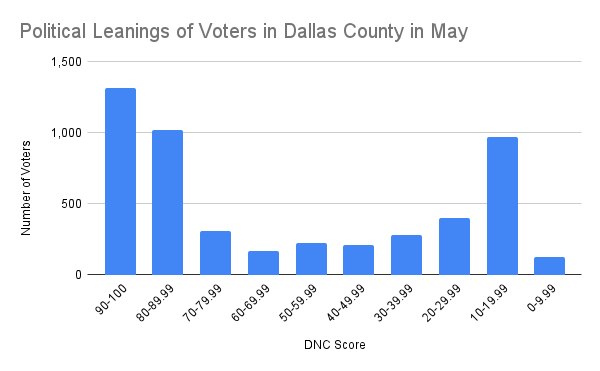
For the county, partisan Democrats constituted 46.46% of the electorate while partisan Republicans accounted for 21.82%. Inconsistent voters clocked in at 31.73%.
So in both the individual community and the entire county, many more partisan Democrats and Republicans cast their ballots than inconsistent voters in the May local election.
Proposition D was passed to try to implicitly solve this problem
Any civic-minded community leader committed to doing the right thing by broadening the electorate, especially for local elections, would not sit idly by as essentially the same pool of Democrats and Republicans continue to battle each other at the polls. And that is the goal of Proposition D in Dallas.
Proposition D, passed in the November 2024 election with an overwhelming 65.13% of the vote, would allow Dallas residents to vote in city council elections “according to state law and as designated by city resolution or ordinance.”
That state law, Senate Bill 1494, authored by Dallas Democratic Senator Nathan Johnson in May 2025 allows cities to move their city council elections from May to November of odd-numbered years.
Going back to Dallas, City Council in November 2025 unanimously approved amending the charter to allow residents to vote in council elections.
So this three-step process, coordinated with Johnson at the state level and the Dallas City Council, now grants voters to choose their council members in the same cycle as the constitutional amendment election.
According to Council Member Chad West, there were three elements to this goal:
Increase voter turnout
Reduce voter fatigue
Save city taxpayers money
We’ve almost surely achieved all three of these objectives. But the tacit hope among many change agents underlying the first of these three — increasing voter turnout — is that registered voters who don’t strongly align with a political party understand the importance of electing their city leaders if the election were held in a more traditional voting month like November, even if that year were odd-numbered. In reality, at least from what we observe in the next set of data, and without the presence of an inspirational and charismatic leader who runs citywide, we might not realize that hope.
Constitutional amendment elections in November
Let’s examine voters’ partisan leanings in a November election in an odd-numbered year. If we take the result of a recent November constitutional amendment in the same community that we witnessed for the May election, this is what we receive:
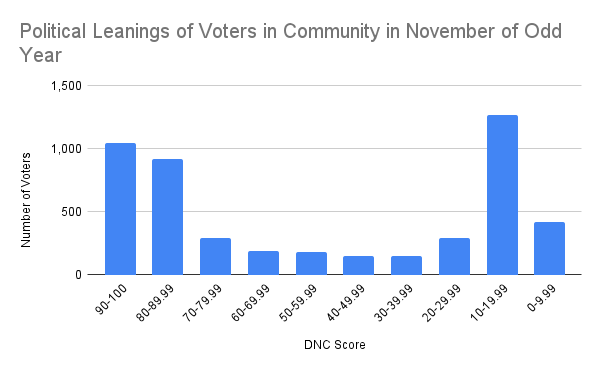
Again, more of the same. Tons of partisan Democrats and Republicans, and not many inconsistent voters. Democrats made up 40.10% of the share, Republicans made up 34.31%, and the rest settled for 25.60%.
I couldn’t create a chart for the entirety of Dallas County for November because VAN’s spreadsheet export doesn’t work for very large datasets. But we can reasonably assume that, much like how the election result for the county mirrored that of the community in the local election, the same partisan divisions took place in the constitutional amendment election.
So will we see a sudden spike of inconsistent voters marching to the polls in November 2027 to decide their local leaders? Perhaps not. Of course, other factors may come into play, but historical data suggests that we notice no significant difference.
What the move might actually do
What moving local elections to November of odd-numbered years has the chance to do, however, is encourage what I call the “lazy partisans” to make their voices heard. This group of voters is the partisan Democrats or Republicans who typically have no desire, or sometimes even forget, that an election in May is happening. Think of them as the friends you have on Facebook who comment on national and state politics with surgical precision but can’t grasp the basics of their communities’ zoning laws. Expect to see them coming out in droves.
In fact, for the community we’ve been inspecting, 4,722 more voters turned out in November than in May. That is an insane 2,609% increase.
Now, will all or even most of those 4,722 voters direct their attention toward the bottom of the ballot to choose their city council leaders after picking their preferred constitutional amendment propositions? Of course not. The undervote risk — when voters ignore down-ballot candidates and causes — presents a real problem in November. But that’s always the issue in any November election, whether it’s a constitutional amendment election, midterm election, or presidential election. We can more than safely predict that at least a good number of those 4,722 voters will select their desired council candidates.
But the fundamental issue, in my view, is not merely increasing voter turnout. We’ve already seen that more people in November of odd-numbered years really means more partisans. The challenge is to motivate inconsistent voters to care about their communities and community political leaders.
How to get inconsistent voters to vote in local elections
Think of these inconsistent voters as the ones you see who work hard to feed themselves and their families. They may privately complain about their landlords’ repeated lack of upkeep or the potholes they need to avoid as they drive to work. Because of this cognitive overload, many simply do not possess the bandwidth to think about electoral politics, and may not even realize that they can complain to their city council member’s office. Instead, they throw their hands up and skip voting altogether.
A number of possible solutions exist to invite these inconsistent voters into the civic fold. Readers of mine are aware that I consistently harp on about the responsibility of local Democratic parties to carry out the difficult, long-term infrastructural work of engaging community members at the local level. Unfortunately, local Democratic Party leaders too often treat that work as secondary to, in their eyes, the more pressing needs of winning elections. If we were serious about building sustainable power from the ground up, though, we would convey more urgency immediately.
But another and far easier method of drawing inconsistent voters to the polls in local elections sits right in front of us: move local elections to November of even-numbered years.
If we crunch the numbers for the community in question for November 2022, the chart looks much more optimistic:
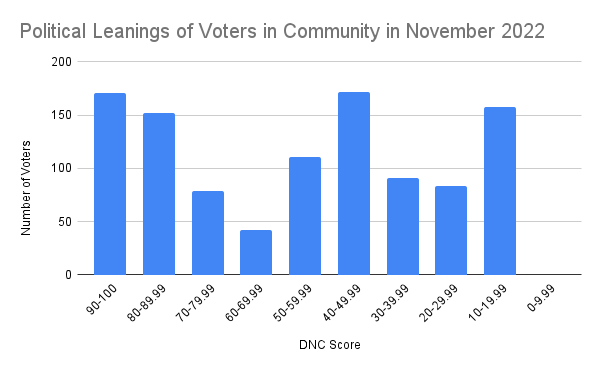
Here, partisan Democrats make up 30.50% of the share while partisan Republicans take home 14.92%. Inconsistent voters? They won the prize: 54.58%.
For November 2024, the presidential election, VAN stopped me from exporting the spreadsheet because of the large amount of data. But if November 2022 gave us any indication, it’s that the result for November 2024 mostly stays the same, if not better, since even more people vote in a presidential election.
Again, will the risk of the undervote somewhat undermine the importance of picking your council members? Yes. But yet again, that risk will always persist. The primary difference between a November in an odd-numbered year and a November in an even-numbered year is not just overall turnout, but more of a chance for inconsistent voters to study their local issues and decide on local leaders.
That does not mean that revisiting Senate Bill 1494 encompasses the sole piece of moving local elections to November of even-numbered years. Politicians and local parties must work in tandem — politicians using their muscle to influence votes in the legislature, and local parties providing the grassroots pressure on politicians — to make a meaningful change in our electoral system.
Possibility of all of this happening?
So will we see local elections taking place in November of even-numbered years? Probably not, at least not in the foreseeable future. Years of research has to first be conducted to strongly suggest that, even though votes for local candidates in November of odd-numbered years now surpass the old model, the vast majority of those votes actually belong to lazy partisans who really should’ve visited the polls in the old model anyway.
Another more sinister reason that local elections will probably not take place in November of even-numbered years is that the Republican Party will never permit it. Republicans fear higher turnout, especially in November of even-numbered years, because they understand that higher turnout commonly means more Democratic voters. Unless we get a radical shift away from the Republican Party at the state level, we’re stuck with dependably partisan voters deciding their local political leaders.
And that is why, again, we need to begin the intentional work from the ground up now.